How much is PIP per month? Every 2026/27 rate, weekly, four-weekly and monthly
PIP per month is worth between £131.30 and £843.27 in 2026/27, depending on your award. Those are monthly equivalents of the weekly rates, which run from £30.30 for standard mobility alone up to £194.60 a week for both enhanced rates. PIP is paid every four weeks, so the top rate arrives as £778.40 per payment.

| Part and rate | Weekly | Every 4 weeks | Monthly equivalent |
|---|---|---|---|
| Daily living, standard | £76.70 | £306.80 | £332.37 |
| Daily living, enhanced | £114.60 | £458.40 | £496.60 |
| Mobility, standard | £30.30 | £121.20 | £131.30 |
| Mobility, enhanced | £80.00 | £320.00 | £346.67 |
| Both enhanced (the maximum) | £194.60 | £778.40 | £843.27 |
PIP rates for 2026/27, weekly, every four weeks and monthly
Personal Independence Payment (PIP) has two parts. The daily living part is for people who need help with everyday tasks such as preparing food, washing, dressing or managing medicines, and the mobility part is for people who find it hard to plan a journey or move around. Each part is paid at a standard rate or a higher enhanced rate, and you can get one part or both. The rates at the top of this page apply from April 2026.
PIP is set as a weekly amount but is usually paid every 4 weeks, so each payment is four times your weekly rate. A year has 52 weeks, which means you get 13 payments a year rather than 12. The monthly figures here are the yearly total divided by 12, which is the fairest way to compare PIP with a monthly budget or a Universal Credit payment.
| Award | Weekly | Every 4 weeks | Monthly equivalent |
|---|---|---|---|
| Standard mobility only | £30.30 | £121.20 | £131.30 |
| Standard daily living and standard mobility | £107.00 | £428.00 | £463.67 |
| Enhanced daily living and standard mobility | £144.90 | £579.60 | £627.90 |
| Standard daily living and enhanced mobility | £156.70 | £626.80 | £679.03 |
| Enhanced daily living and enhanced mobility | £194.60 | £778.40 | £843.27 |
The most anyone can get is both enhanced rates together, £194.60 a week. That comes to £778.40 every four weeks, around £843.27 a month and £10,119.20 over a full year. The smallest award is standard mobility on its own, £30.30 a week or £1,575.60 a year.
How many points you need for each rate
PIP is not decided by your diagnosis. It is decided by how your condition affects you, scored against a set of daily living and mobility activities. For each activity the assessor picks the statement that best describes you, each statement carries points, and the points are added up separately for each part. The PIP regulations set these thresholds.
| Points in that part | Daily living part | Mobility part |
|---|---|---|
| 0 to 7 points | Nothing for this part | Nothing for this part |
| 8 to 11 points | Standard rate, £76.70 a week | Standard rate, £30.30 a week |
| 12 points or more | Enhanced rate, £114.60 a week | Enhanced rate, £80.00 a week |
There is also a time test. Your difficulties must have been present for at least 3 months and be expected to last at least a further 9 months, and you must have difficulty on more than half of the days over a 12-month period. For each task the assessor looks at whether you can do it safely, how long it takes, and whether you need help from a person or extra equipment.
Sandra is an invented claimant with severe arthritis. She needs supervision to prepare a simple meal (4 points), help to wash (2 points) and help to dress (2 points), giving 8 daily living points and the standard rate of £76.70 a week. She can only walk between 20 and 50 metres with a stick, which scores 10 mobility points and the standard mobility rate of £30.30. Her total is £107.00 a week, paid as £428.00 every four weeks.
When PIP is paid and how back pay works
The law says PIP is paid four-weekly in arrears, so each payment covers the four weeks just gone. Your decision letter gives the date of your first payment, your usual payment day, how long your award lasts and when it will be reviewed. If a payment date falls on a bank holiday you are usually paid before it. People claiming under the special rules for end of life can be paid weekly in advance.
Back pay is the part many people underestimate. For a phone claim, your claim date is the day the phone claim is properly completed. When PIP is awarded it runs from that date, so your first payment includes the weeks you spent waiting for a decision. The DWP can only split large arrears into instalments if it thinks this protects you and you agree.
Peter, an invented claimant, completes his phone claim and gets a decision 16 weeks later awarding standard daily living. His first payment would include around 16 weeks at £76.70, which is £1,227.20, and then £306.80 every four weeks.
Your first award will last between 9 months and 10 years, depending on whether your needs are likely to change. You keep getting PIP while a review is carried out.
Is PIP means tested or taxable
PIP is not means tested. GOV.UK says the amount you get is not affected by your income or savings, and you can get it whether you are working or not. A partner's wages, a works pension or money in the bank make no difference to whether you qualify or how much you get.
PIP is also tax free. HMRC lists it among the state benefits you do not pay Income Tax on, so it does not use up your tax-free Personal Allowance. Adult Disability Payment in Scotland is tax free too. In September 2026 the government's Timms Review of PIP said PIP should remain a flexible, non-means tested benefit.
Because PIP ignores income and savings, people turned down for means-tested help in the past can still qualify. It is worth checking even if you work full time.
How PIP affects your other benefits
PIP is paid on top of your other benefits. GOV.UK says you can get it alongside all other benefits except Armed Forces Independence Payment, and it often unlocks extra help.
- Pension Credit can include an extra £86.05 a week for severe disability if you get the daily living part, although this usually stops if someone gets Carer's Allowance for looking after you.
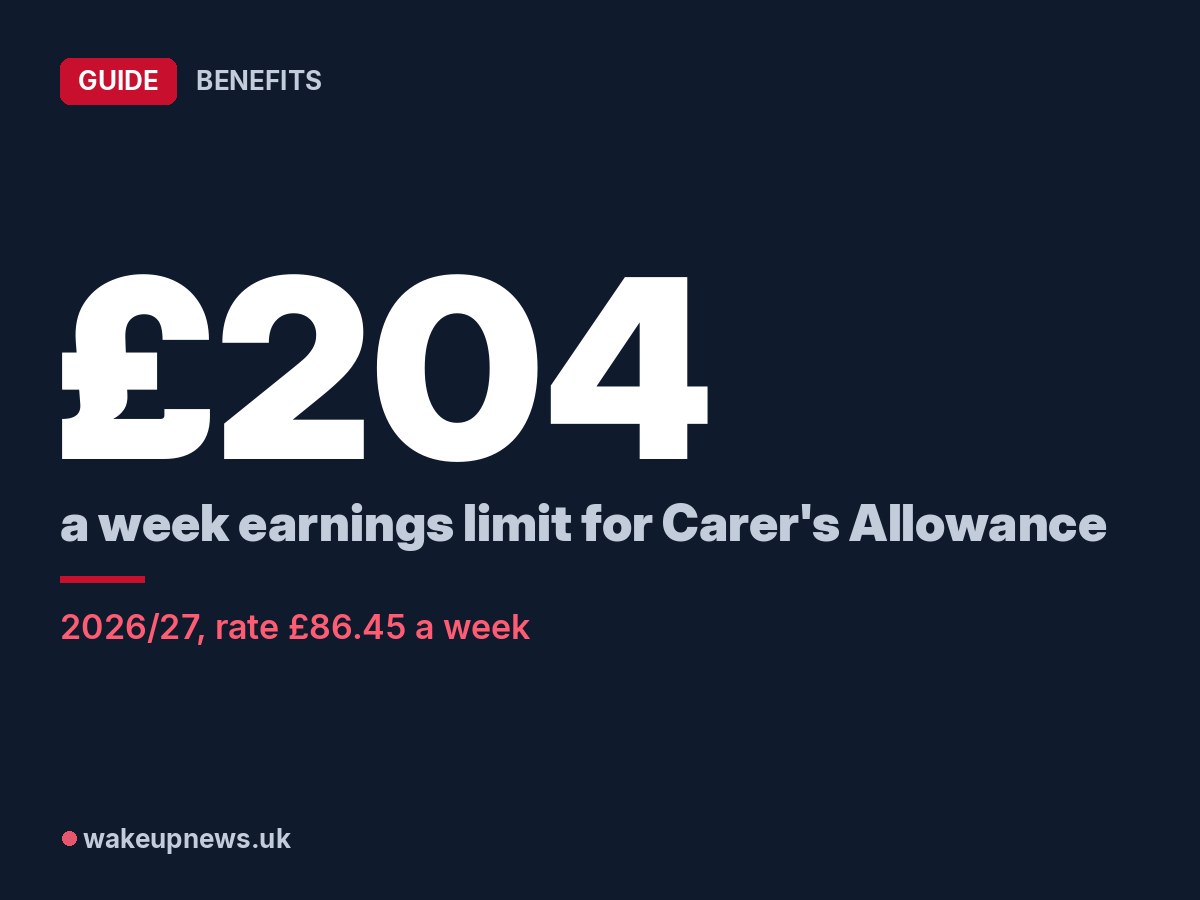
- Someone who cares for you at least 35 hours a week may be able to claim Carer's Allowance of £86.45 a week, because the daily living part is a qualifying benefit.
- With income-related Employment and Support Allowance or Housing Benefit, PIP can add a disability premium.
- The benefit cap does not apply if you, your partner or a child living with you gets PIP.
- The mobility part can lead to a Blue Badge and a vehicle tax discount, the enhanced mobility rate opens the Motability Scheme, and either part qualifies you for a Disabled Persons Railcard.
Two payments do reduce PIP. Constant Attendance Allowance cuts the daily living part, and War Pensioners' Mobility Supplement means no mobility part. If you lease a car through Motability, see our report on the Motability mileage allowance cut.
Reaching State Pension age does not end an award you already have. Under the PIP regulations, if you were entitled to PIP on the day before you reached State Pension age, the age limit does not apply and your award carries on, subject to the usual reviews. New claims are different. Over State Pension age you usually cannot make a new PIP claim unless you got PIP or Adult Disability Payment in the last 12 months, and you would claim Attendance Allowance instead, which pays £76.70 or £114.60 a week but has no mobility part. Our guide to benefits that stop the day you reach State Pension age covers the wider picture.
PIP in Scotland and Northern Ireland
In Scotland, new claims go to Adult Disability Payment (ADP), run by Social Security Scotland. ADP is paid at the same rates as PIP in 2026/27, it is tax free, and income and savings are not taken into account. The differences are mostly about payment and moving home.
| PIP (England and Wales) | Adult Disability Payment (Scotland) | |
|---|---|---|
| Run by | Department for Work and Pensions | Social Security Scotland |
| Weekly rates | £76.70 or £114.60 daily living, £30.30 or £80.00 mobility | The same rates |
| How often paid | Every 4 weeks in arrears | Every 4 weeks, with the first payment after the first 4 weeks |
| Paid from | Your claim date | The date you submitted or completed part 1 of the application |
If you get PIP and move from England or Wales to Scotland, tell the DWP and claim ADP straight away, because your PIP will stop 13 weeks after you move. Moving the other way, tell Social Security Scotland and claim PIP as soon as you arrive.
In Northern Ireland PIP is run by the Department for Communities. The rates are the same, it is paid every four weeks, it is tax free and it ignores income and savings. Over State Pension age, nidirect says you can still make a new claim if you were eligible for PIP in the year before you reached State Pension age.
How to claim PIP and check your award
- Call the PIP new claims line on 0800 917 2222, Monday to Friday, 8am to 5pm, or write to Freepost DWP PIP 1. In some areas you can apply for PIP online. Have your National Insurance number, bank details and GP's details ready.
- Return the 'How your disability affects you' form within 1 month, with evidence such as prescription lists, care plans or letters from your doctor. Call the PIP enquiry line if you need more time.
- You may be invited to an assessment in person, by phone or by video call. It usually takes 1 hour and you can bring a friend or support worker.
- If you disagree with the decision, ask for a mandatory reconsideration within one month of the date on your decision letter.
To check your award, start with your decision letter, which shows the amount, payment day and review date. You can also sign in to your PIP account if you have registered, or call the PIP enquiry line on 0800 121 4433. If you need a letter proving you get PIP, for a council discount or a railcard, use the GOV.UK service to get proof of your benefits.
Tell the PIP enquiry line straight away if your needs change, you go into hospital or a care home, or you plan to go abroad for more than 4 weeks. Late reports can lead to an overpayment.
What changes next for PIP
PIP rates normally rise each April. The 2026/27 rates were set out in a written ministerial statement on 26 November 2025, and the April 2027 rates are normally announced around the same time of year. We will update this guide when they are confirmed.
The bigger question is the Timms Review of PIP. In September 2026 its co-chairs published emerging recommendations, including fewer award reviews for people with lifelong or degenerative conditions, a simpler PIP2 form, better handling of fluctuating conditions and a review of the 28-day hospital rule. They are not final, the final report is due later this autumn, and recommendations do not change anyone's award on their own. Political parties are also arguing about disability spending, which we covered in our report on who would be hit by the Conservative welfare cuts plan.
Frequently asked questions
How much is PIP per week in 2026?
From April 2026 the PIP daily living part is £76.70 a week at the standard rate or £114.60 at the enhanced rate. The mobility part is £30.30 standard or £80.00 enhanced. You can get one part or both, so weekly PIP ranges from £30.30 to £194.60.
How much is the highest rate of PIP?
The highest rate is enhanced daily living plus enhanced mobility, £194.60 a week. Paid every four weeks, that is £778.40 per payment, about £843.27 a month or £10,119.20 a year. You need at least 12 points in each part to get it.
How much is a PIP payment every 4 weeks?
Each payment is four times your weekly award. Standard daily living on its own is £306.80, enhanced daily living is £458.40, standard mobility is £121.20 and enhanced mobility is £320.00. The largest combined payment is £778.40, and you get 13 payments a year.
Is PIP means tested?
No. PIP is not affected by your income or savings, and you can claim it whether you work or not. Your partner's earnings, your pension and money in the bank do not change the amount. What counts is how your condition affects everyday tasks and getting around.
How much will my PIP back payment be?
PIP runs from your claim date, which for a phone claim is the day the call is properly completed, so your first payment includes the weeks you waited for a decision. To estimate it, multiply your weekly award by the weeks since you claimed. For example, 16 weeks at £76.70 is £1,227.20.
Is PIP taxable?
No. PIP is on HMRC's list of tax-free state benefits, so you do not pay Income Tax on it and it does not use up your Personal Allowance. Adult Disability Payment in Scotland is also tax free, while Carer's Allowance paid to someone who looks after you is taxable.
What is PIP?
Personal Independence Payment is a benefit for people aged 16 or over with a long-term physical or mental health condition or disability who find everyday tasks or getting around difficult. You usually need to be under State Pension age to make a new claim, and you can get it whether you work or not.
How much PIP do you get with 8 points?
Eight points in a part gives you the standard rate for that part, which is £76.70 a week for daily living or £30.30 a week for mobility. Twelve points or more moves you up to the enhanced rate, £114.60 for daily living or £80.00 for mobility.
Sources
- GOV.UK, Personal Independence Payment (PIP): how much you'll get, accessed 2 October 2026
- Department for Work and Pensions, Benefit and pension rates 2026 to 2027, accessed 2 October 2026
- legislation.gov.uk, The Social Security (Personal Independence Payment) Regulations 2013, regulations 5, 6 and 25, accessed 2 October 2026
- legislation.gov.uk, Universal Credit, PIP, JSA and ESA (Claims and Payments) Regulations 2013, regulations 12 and 48, accessed 2 October 2026
- Department for Work and Pensions, PIP assessment guide part 1: the assessment process, accessed 2 October 2026
- Department for Work and Pensions, PIP assessment guide part 2: the assessment criteria, accessed 2 October 2026
- GOV.UK, Tax-free and taxable state benefits, accessed 2 October 2026
- GOV.UK, Pension Credit: what you'll get, accessed 2 October 2026
- GOV.UK, Benefit cap: when you're not affected, accessed 2 October 2026
- GOV.UK, Attendance Allowance, accessed 2 October 2026
- GOV.UK, Carer's Allowance: eligibility, accessed 2 October 2026
- GOV.UK, Challenge a benefit decision (mandatory reconsideration), accessed 2 October 2026
- mygov.scot, Adult Disability Payment, accessed 2 October 2026
- nidirect, Personal Independence Payment (PIP), accessed 2 October 2026
- Department for Work and Pensions, The Timms Review: co-chair update, September 2026, accessed 2 October 2026
How we check this guide. Every figure is checked against the official sources listed above, and the guide is updated when rates or rules change.